

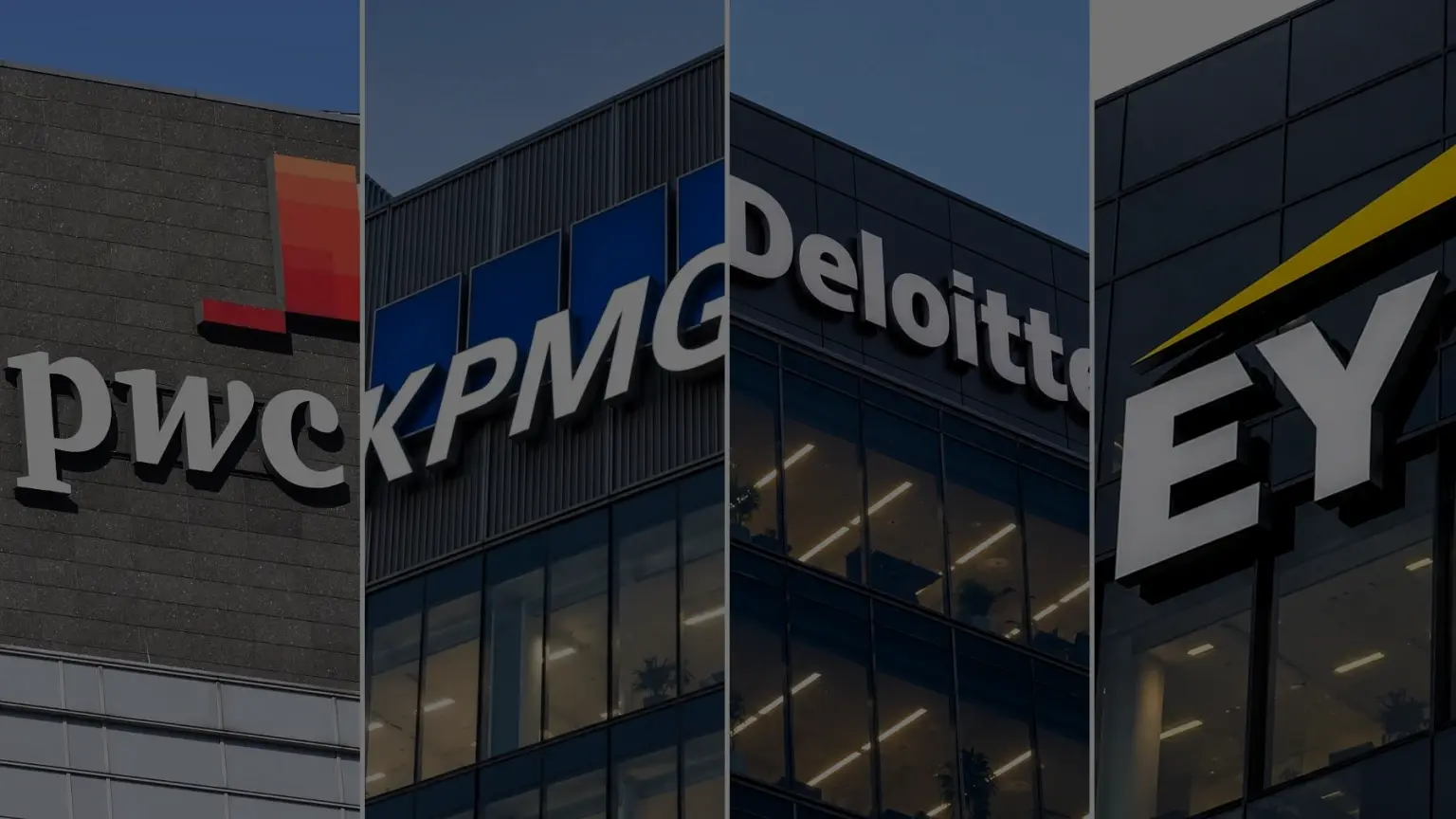

Wilkinson Group’s Peter Wilkinson looks at the trust crisis enveloping the four big accounting firms, and recommends a course of action to mitigate government intervention.

The lineup: Timing is important now for the Big Four accounting firms
One of my bosses once said, “If I get involved in your dispute, neither of you will like the outcome. Sort it out yourselves.”
That line has stayed with me for decades. It’s exactly the choice facing the Big Four accounting firms right now, as their carefully manufactured trust reputations come apart in public.
KPMG Australia refused to sort it out itself. As a result, under pressure, in June 2026, chairman Martin Sheppard and audit partners Paul Rogers and Eileen Hoggett announced they would leave KPMG Australia, following the earlier exits of CEO Andrew Yates and audit head Julian McPherson.
A parliamentary committee had just heard whistleblower allegations that staff used confidential Optus information to help win a rival Telstra audit tender, and used Lendlease board papers to support other bids too.
Interim chief executive Stan Stavros summed it up simply: “We did not meet the standards expected of us.”
That admission came late. And lateness, more than the original failure, usually decides how long a crisis runs.
KPMG isn’t alone. It’s the same probity failure that ended PwC’s 2022 tax scandal. EY has made its own headlines, with graduate staff using privileged access to uncover the Prime Minister’s personal banking details.
While the public sees “rotten to the core”, the Department of Finance has placed more than $270m in KPMG government contracts under review.
Assistant Treasurer Daniel Mulino said the scandal was prompting a fresh look at reform options, including capping partner numbers and bringing the Big Four under the Corporations Act.
Treasury has gone further, releasing an Options Paper that floats breaking up the firms altogether, with ASIC replacing self-regulation.
The coverup is the second crisis

The author – Peter Wilkinson
Every organisation under scrutiny wants time: time to consult lawyers, assess exposure, shape the message. Sheppard’s early move to shield documents behind legal privilege was probably ordinary caution. The parliamentary committee saw concealment.
So, the story doubled. A slow, guarded response rarely buys protection. It creates a second narrative, the cover-up, and that narrative is usually harder to survive than the original failure, because journalists and committees read hesitation as evidence.
Journalists like Ed Tadros at the AFR ask a simpler question: what is KPMG hiding, and why does it need privilege to hide it? That’s the story editors chase, not the underlying breach. Corporate leaders rarely think like editors, but they should because editors can measure community expectation in readers’ clicks.
It is instinct to protect information that so often backfires.
Trust = Truth, Transparency, then Traceability. The alleged misuse of Optus information was a truth failure. Hiding behind privilege was a transparency failure. And a parliamentary committee ended up supplying the traceability, forever.
That sequencing matters beyond this one case. Boards can hide less with AI, and increasingly have to assume a regulator, journalist, or committee will eventually trace what happened, whether or not the organisation volunteers it first.
Legal caution and reputational judgment are different disciplines, and the second is too often subordinated to the first.
We’ve been here before
The banking industry’s failure to self-regulate produced the Royal Commission of 2017-19, where fee-for-no-service and aggressive upselling became daily headlines. The result was legislation that now spells out “honesty and integrity,” “due skill, care and diligence,” and “reasonable steps.”
The lessons for leaders, even back then, were in plain sight. CBA presciently changed leadership to Matt Comyn ahead of the RC, apologies included. Compare that to NAB’s Ken Henry, who Commissioner Kenneth Hayne said he was “not as confident as I would wish to be that the lessons of the past have been learned.” Henry stepped aside with CEO Andrew Thorburn.
Franchising tells the same story. A parliamentary inquiry into the Franchising Code, launched in 2018, found systemic abuse and a persistent power imbalance between franchisors and franchisees, with the tenacious Senator Deborah O’Neill, now leading the Big Four inquiry, one of its most forceful voices. A mandatory code had been introduced in 1998, and yet the inquiry concluded it still needed to be strengthened.
The slow learners at the Big Four must surely know that what’s coming will probably be harsh. They didn’t “sort it out’ themselves.
Where the fix has to start
We advise clients to begin with the old guard at the top, now damaged and conflicted. Clean out the board, replace it with a majority of experienced independent directors, who must act with policies, probity and punishment, ahead of the current culture of “win at all costs”.
Cleaning out so many senior executives who presided over the mess, ahead of the fix, means the new people inherit their predecessors’ sins. It’s a common fix, it’s good cosmetics, and sometimes necessary, but it needs forethought because it forces the newbies to inherit a poisoned chalice. You handicap the very people you need.
Then, make the fixes ahead of any inquiry recommendations. “Done that” and “done that too” creates confidence and trust, especially with clients and staff.
After the fixes, rigorous implementation must follow, with punishment for the slow learners.
Roy Morgan research reinforces what we see in practice: the first months out of a crisis demand intense reform, followed by a slow shift from distrust to neutral. Trust itself can take five years or more to return, provided there’s no further misbehaviour.
The personal reputation question
Sheppard and Yates didn’t just lose their roles. They became the public face of a scandal that will follow them past their appointments. Leaders consistently underestimate how quickly an institutional failure turns personal.
A chief executive or chair needs a personal message in moments like this: what they knew, when they knew it, what they’re doing differently now. Stakeholders read a failure of communication as dishonesty.
A statement that sounds legally cleared, rather than personally meant, does not cut it in 2026.
The question the Big Four need to answer
Given their prudential and assurance work, do these firms really want their profession legislated the way banking and franchising have been?
This crisis is playing out on the most serious stage there is, the Australian Parliament. These firms know the scandals; they know their own weak points better than anyone, and they’ve now been told what legislators could do to them.
They have a choice: sort it out themselves, or have the changes made for them.
Update, October 2026:
KPMG’s clients are now viewing their mistakes way the committee did.
IAG ended a 26-year audit relationship worth $11.6 million a year. New allegations emerged that a Macquarie director helped KPMG wargame its bid for the bank’s audit. Every fresh disclosure resets the reputational clock.
The reviews follow a pattern. Allens was first, then Ashurst, then Andrews Group and Gentilin. KPMG sets the scope. Someone else takes it apart.
Another organisation faced the same choice about what the public should see. OpenAI published what made it look bad. KPMG withheld the evidence until a televised committee forced its hand.


