
Social media has handed public relations practitioners an extraordinary number of new options for generating coverage, or what we used to simply call news. Citizen journalism is genuinely exciting. The outlets available to any organisation with something to say are, for the first time, almost unlimited.
That abundance has created a problem of its own. Before we get swept up in the possibilities, we need to draw a clear line between two things that sound similar but are not: visibility and credibility

The author – Peter Wilkinson
Self-awareness comes before self-control
There is a persistent tendency among enthusiastic practitioners to treat high visibility as the objective in itself. The old line, “all publicity is good publicity,” still gets repeated as though it were strategy rather than a shortcut. We see the consequences of this constantly in social and online media, in the silly tweets designed purely to get noticed, and in the inane, often irritating questions posted into LinkedIn groups purely to generate engagement.
As a rule, we do not always want high visibility. We always want high credibility. Public relations, done properly, steers away from strategies built solely to generate visibility, usually on the hopeful assumption that credibility will follow behind it. It rarely does. This distinction matters just as much for marketers using public relations as an alternative to advertising as it does for practitioners using the internet as an alternative to traditional media.
The temptation inside many organisations is for senior leaders to instruct their communications teams with a brief that sounds reasonable but is not: “we want lots of stories, and no negative media, please.” That is a request for visibility. It is not a strategy for credibility, and the two are frequently at odds with each other.
The quadrant that explains where organisations actually sit
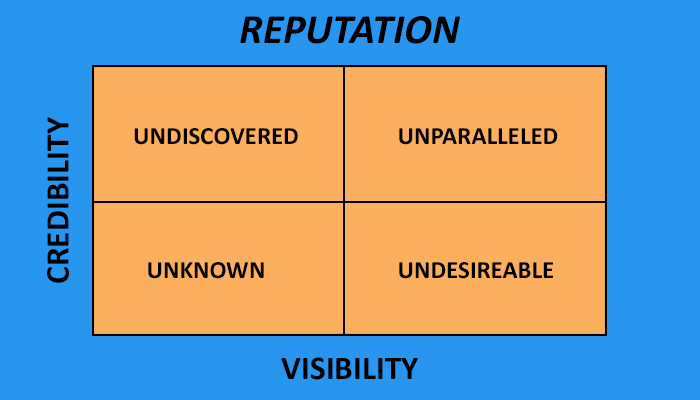
measuring public relations
A close colleague of mine, Chris Sherbon of Synthesis Consulting, developed a simple model that makes this distinction easier to see in practice. Every organisation, without exception, starts in the same place: Unknown. That is the necessary starting point for any start-up. It is also, worth noting, the preferred hiding place for conmen, fraudsters, and bank robbers.
From Unknown, an organisation can move in one of two directions. The first is what I call the Undesirable path: moving sideways with quick commentary designed purely to build visibility, in the hope that a good reputation will develop later. Organisations that follow this path can get stuck with a tacky reputation sitting in the lower quadrant, at which point they tend to need crisis public relations, because journalists have started writing negative material about them.
The second, recommended direction is to move upward first, using credible, well-researched commentary, into what the model calls the Undiscovered quadrant. Coverage here is less frequent, but it is far more credible. From that position, an organisation can then move sideways into visibility when the opportunity genuinely presents itself. Getting stuck in this quadrant is a far better problem to have. Fewer customers, perhaps, but the ones you do have believe you hold a genuine reputation, and journalists who do write about you tend to write positively.
Applying it beyond the boardroom
This is not only a corporate question. It applies just as well to public figures, and it is worth setting as an exercise for anyone following public relations and crisis management: where does a figure like Julia Gillard sit on that chart? Where does Tony Abbott sit? What about your own clients? What about you?
The exercise is useful precisely because most people cannot answer it quickly. A leader can be extraordinarily visible and still lack credibility with the audiences whose trust actually matters, media, colleagues, or the public. Equally, a leader can hold deep credibility within a smaller circle while remaining almost invisible more broadly. Neither position is automatically wrong. What matters is whether the position was chosen deliberately, as part of a considered communications strategy, or arrived at by accident, through years of reactive decisions made under deadline pressure.
Why the distinction still holds
Social media has not changed the underlying principle here, it has simply made the consequences of getting it wrong more visible, and faster to arrive. A quick hit designed only for visibility can generate a burst of attention within hours. It can also generate a backlash just as quickly, particularly if the material behind it does not hold up to scrutiny. Citizen journalists and engaged commentators are, in effect, unpaid fact-checkers now embedded across every platform an organisation might use.
For senior communications advisers, the practical implication is straightforward. Resist the brief that asks only for volume. A strategy built around generating “lots of stories” without regard for their substance is a visibility strategy dressed up as a public relations strategy, and the two are not interchangeable. The organisations and leaders who invest instead in credible, well-researched commentary tend to build something that survives contact with a difficult news cycle, rather than something that collapses the first time it is tested.
This is also where the distinction between reactive and proactive communications becomes important. An organisation that has spent years building credibility through consistent, well-researched public commentary is far better placed to manage an emerging issue quietly, before it escalates into something requiring crisis communications. One that has spent the same years chasing visibility instead usually finds it has no credibility reserve to draw on when a genuine crisis arrives, and no issues management groundwork already in place to soften the impact.
The question worth asking of any organisation
Before signing off on the next communications plan, it is worth putting the same exercise to your own organisation that I have set above for public figures. Are you positioned in the Unknown quadrant, deciding which direction to take next? Have you drifted sideways into the Undesirable quadrant, chasing visibility and hoping credibility will eventually catch up? Or have you taken the slower, less glamorous route into the Undiscovered quadrant, building a reputation that holds up under scrutiny even while your visibility remains modest?
There is no prize for being the most visible organisation in your sector if nobody actually believes what you say. Credibility is the harder thing to build and the more valuable thing to hold. Visibility, chased for its own sake, is rarely worth what it costs to acquire.
By Peter Wilkinson
Managing Director
Wilkinson Group