


Wilkinson Group’s Peter Wilkinson examines Optus CEO Stephen Rue’s handling of the deadly Triple Zero outage, and argues the failure was not the man but the comms strategy around him.
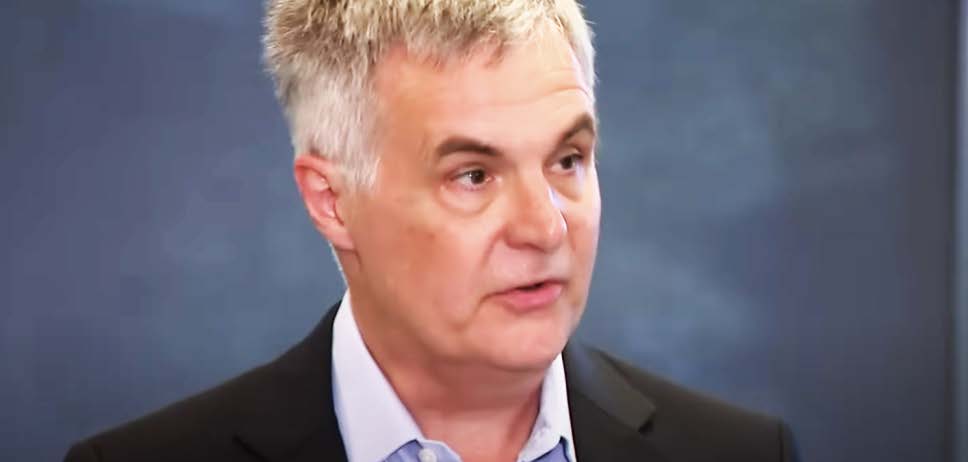
Optus CEO Stephen Rue, reading the 000 apology (Sky News) last September
Don’t rush to sack Optus boss Stephen Rue. Singtel’s public interference in the fallout is one problem. A more useful explanation is simpler: Rue is a poor communicator, so he leaned on his communications team, and that team was not built for a crisis of this scale. What followed was a series of avoidable missteps, culminating in press conferences that did more damage to Optus than the outage itself.
The lesson here is not really about Optus. It is that in a catastrophe involving loss of life, the audience needs emotion and humanity before it needs process, and a technical explanation delivered instead of a human one will always make a crisis worse, not better. That single principle explains almost everything that went wrong for Optus in the days after its Triple Zero failure, and it applies equally to any leader who finds themselves standing in front of cameras after something has gone badly wrong.
The stakeholder list came first, and Optus missed it
A crisis response lives or dies on the stakeholder list drafted before anyone speaks publicly, and Optus appears not to have had one. South Australian Premier Peter Malinauskas and Western Australian Premier Roger Cook were both left off it, despite the outage running through their states. Malinauskas’ public fury after the fact was entirely predictable. A premier facing questions about deaths in their own state needs early warning and a recommended line from the company involved, so they can respond with something comforting rather than being caught flat-footed on camera.
Optus needed to be seen as nimble and empathetic from the first hour, not the third day. Every message that followed needed to reinforce that impression, because a slow or evasive start does not buy an organisation time. It manufactures a second story, the one about the cover-up, which is often more damaging than the original event. Wilkinson Group’s crisis communications work exists precisely for this window, when the first hours determine whether an organisation controls its own story or has it written for them.
A Friday night press conference is a tell
Holding a press conference late on a Friday night, the timeslot cynical political operators reserve for burying bad news, was a signal in itself. The Canberra press gallery would have noticed immediately. The first announcement should have gone out as soon as the outage was detected, long before the story spiralled and the worst consequences became public.
Timing decisions like this are exactly why Wilkinson Group treats the golden hour of crisis response as a discipline, not a figure of speech. An organisation that has rehearsed its first hour does not accidentally schedule its worst news for the moment least likely to be covered fairly.

The author, Peter Wilkinson
An apology read from notes is not an apology
Whoever allowed Rue to read his apology from a script made a serious error. Facts can be delivered from notes. An apology has to be spoken, because it needs to connect with an audience that is grieving and angry, not reassure them with process. That distinction is why rehearsal matters so much for the moments that carry the most emotional weight, and why Wilkinson Group’s media training work focuses as much on delivery and presence as it does on message content.
Consider the families of the people who died attempting to call Triple Zero. They sat at the top of any credible stakeholder list, yet Rue told reporters he had not personally reached out to them. Asked directly whether he had spoken to the families, his answer referenced fact-checking and ensuring the right process was followed, with contact promised “at the right time.” That answer is the clearest evidence of the disconnect running through the whole response: the public was thinking about grieving families, and the CEO was talking about internal process.
The gap between what people feel and what leaders say
This is not a new problem. Four decades of Australian current affairs journalism, from Mike Willesee to Jana Wendt, built entire interviews around one blunt question to a politician or executive: have you spoken to the victim’s family? A “no,” followed by silence, told the audience everything it needed to know. A brief, personal, apologetic call from someone as senior as an Optus CEO would, in almost every case, have been received with real gratitude. Rue could have said plainly that he had spoken to the families personally and privately, and that Optus would give them whatever support it could. Instead, the audience heard about process, while a comparable disconnect showed up again when Rue was asked whether he had personally listened to the two Triple Zero calls that failed. He had not, though he said senior staff had, and specifics on what those calls revealed were deferred to a later update.
The advice available to him was straightforward: listen to the calls yourself, because you will be asked about them, and check in on the people at the call centre who took them, because they may be traumatised too.
The technical failure was a cultural one
Behind any failure of this scale sits a chain of people who share responsibility, from whoever wrote the faulty code through to whoever signed off on the upgrade and the executive who approved the budget behind it. Calling that a technical and process failure, as Rue did, is accurate but tone-deaf. It is completely disconnected from what the public, and likely thousands of Optus staff who shared the shock, actually wanted to hear.
A more honest public line was available: that Optus had a cultural problem, that Rue was determined to fix it despite being new to the role, and that the standard every employee walks past is the standard the organisation accepts. That is a message people remember, because it names the real issue rather than hiding behind the technical one. It is also the kind of message that requires senior counsel in the room before the crisis breaks, which is the entire premise behind Wilkinson Confidante, rather than assembled from scratch at 11pm.
What comms teams should take from this
For comms leaders watching this play out, the practical lessons are consistent and apply well beyond telecommunications:
- Rehearse properly. It is not a compliance exercise.
- Build a small, trained team with real authority to act.
- Be clear on the aim first. It is rarely as simple as stopping the media cycle.
- List every stakeholder with a specific objective for each one, because knee-jerk tactical responses are dangerous when the aim is not clear.
- Nail the messaging before implementation begins.
- Support the spokesperson visibly, before and during.
- Commit to the plan, while staying nimble enough to change it as circumstances shift.
- Resource the response properly. Time, people, and budget are the enemy of a slow crisis team.
The question every CEO needs to answer before the next crisis
Rue’s personal reputation survived this because the story, correctly read, was never really about him. It was about a communications function that had not rehearsed for the scenario that actually happened, and a leader who was left to represent facts he had not been coached to deliver with humanity. Any board asking whether their own CEO would fare better in the same room has already identified the gap worth closing, and it sits in the preparation, not the person.


