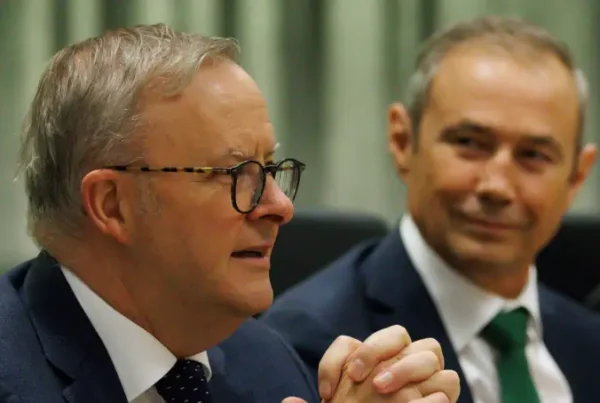
Don’t we get frustrated when politicians don’t answer questions !? It contributes to our distrust of them. Here’s an easy fix.
Q=A+M. Question equals Answer plus Message.
Answer the question, yes. But bridge to the message you came to deliver. The journalist gets their quote. You get your point into the story. Both sides leave with something.
‘A’ Matters
Here’s why the A matters more than most spokespeople realise.
When a question is asked on camera, on radio, in a meeting, even at a dinner party, the listener answers it in their head. Instantly. Before the person being asked opens their mouth. It takes milliseconds. Everyone does it, every time, without thinking.
The gap between one person finishing a sentence and another starting their response is roughly 200 milliseconds, sometimes less! Listeners aren’t waiting for the question to end. They’re predicting the answer while it’s still being asked [1].
When the answer comes back and it matches what the listener already concluded, there’s trust. The listener thinks: that’s honest. Now they’ll listen to whatever comes next, the M, the message, the point you actually came to make.
When the answer comes back different from what the listener expected, something more interesting happens. The listener’s thinking is disrupted. In milliseconds, they make a judgment. Either they think: that’s rubbish. Or they think: hang on, maybe I had that wrong. Either way, they’re engaged. They’re weighing evidence. They’re listening harder, not less [2].
Match the expectation with honesty, and you gain trust. Violate it with evasion, and you lose it.
Now the M, the Message, lands on a listener who is genuinely thinking, not just nodding.

The Author – Peter Wilkinson
How Not to Do It
Politicians have turned this into a masterclass in how not to do it. They skip the A entirely. Q=M. Question straight to Message. No answer at all. Anger. Frustration.
It’s one reason politicians are so widely distrusted. Not because their policies are wrong. Because they won’t answer a question, and every loungeroom watcher knows it.
This isn’t just a media interview phenomenon. It happens in every conversation. A colleague asks a question in a meeting. Your teenager asks why they can’t go out. The listener has already answered the question before you have. Skip the A and they stop trusting you. Deliver the A, even when it’s uncomfortable, and you’ve earned the right to the M.
Remembering Q=A+M
I developed Q=A+M for CEOs and directors who are smart, articulate people, but like all of us, forget. The challenge was to create something easy to remember, like the times tables we rote-learn in primary school.
There is ample data on how quickly people forget. Famously, in 1885, German psychologist Hermann Ebbinghaus showed that memory drops steeply in the first hours, then levels off into a long, gradual decline [3]. That work has been repeated often.
The only reliable counter is repetition.
That’s why Q=A+M works: it’s short enough to repeat in your head before the camera rolls.
The best crisis communications happens before the crisis. Media training is a critical part of reputation management. It happens in a room where someone practises bridging from a hostile question to a clear message, gets it wrong, and tries again. Not on the morning the story breaks.
Q=A+M is simple enough to remember under pressure. That’s the point.