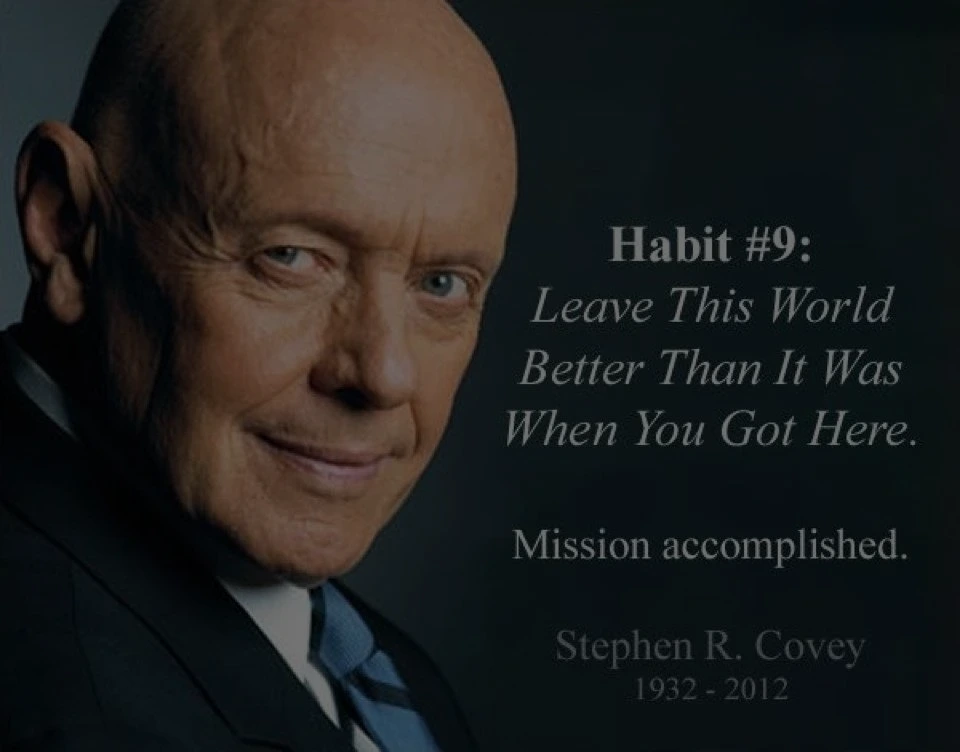
Stephen Covey’s ‘7 Habits’ outlived him. He remains one of the clearest thinkers on personal leadership I’ve come across, and whenever I lose track of the ‘7Hs’, I go back to the book to remind me.
Covey, along with a small group of others, like Jim Collins (Good to Great) and Martin Seligman (Learned Optimism) are the people other ‘How To’ authors are measured by.
Covey’s ‘Habits’ are fundamental to almost all stakeholder relations: community, internal, government, media. As a PR and crisis communications consultant, the two I use most are ‘Think win/win’ and ‘Seek first to understand, then to be understood’, but their power is as 2 of an integrated 7 personal skills.
How I Use Covey’s Habits in Crisis and Media Work
I use both in media training sessions before an executive fronts a press pack, and in the first hour of a live issue, when the instinct is to defend before anyone has actually listened. Diagnose before you draft the statement. That one habit, seek first to understand, has saved more clients from a bad first day than any plan I’ve written.
Below is a piece written by Susan Young. We couldn’t have written it better…
7 leadership lessons from Stephen Covey

The author – Peter Wilkinson
The death of the ‘7 Habits’ author reminds us of what a profound leadership authority he will remain for generations to come.
By Susan Young | Posted: July 19, 2012
In 1989, Stephen Covey’s profound book, “The 7 Habits of Highly Effective People,” had the business world raving. Since that time, new generations have entered the workforce. Do relative newcomers to business know the name Stephen Covey? Are they introduced to his international bestseller in college? Yes, Malcolm Gladwell, Daniel Pink, and brothers Chip and Dan Heath have come along with profound business and leadership messages. But Covey’s teachings should not be put on the back burner.
Covey, 79, passed away yesterday, July 16. He left quite a legacy.
I dusted off my tattered copy of “The 7 Habits” and realized I was overdue for a refresher course.
For the folks who were reading Dr. Seuss in 1989, here are seven takeaways:
Habit No. 1: Be proactive. “Self-awareness enables us to stand apart and examine even the way we ‘see’ ourselves. Our self-paradigm, the most fundamental paradigm of effectiveness. It affects not only our attitude and behaviors, but also how we see other people. It becomes our map of the basic nature of mankind.”
Habit No. 2: Begin with the end in mind. “This habit is based on the principle that all things are created twice. There’s a mental or first creation, and a physical or second creation to all things.” In other words, visualize what you want as if it already happened and the universe will begin to work wonders.
Habit No. 3: Put first things first. This habit is about personal and time management. Covey writes: “Management, remember, is clearly different from leadership. Leadership is primarily a high-powered, right brain activity. It’s more of an art; it’s based on a philosophy. You have to ask the ultimate questions of life when you’re dealing with personal leadership issues. But once you have dealt with those issues, once you have resolved them, you then have to manage yourself effectively to create a life congruent with your answers.”
Habit No. 4: Think win/win. According to Covey, “This is a frame of mind and heart that constantly seeks mutual benefit in all human interactions. Win/win means agreements are mutually beneficial, mutually satisfying… Most people think in terms of dichotomies: strong or weak, hardball or softball win or lose. But that kind of thinking is fundamentally flawed.”
Habit No. 5: Seek first to understand, then to be understood. “We have such a tendency to rush in, to fix things up with good advice. But we often fail to take time to diagnose, to really, deeply understand the problem first… This principle is the key to effective interpersonal communication.”
Habit No. 6: Synergize. On synergistic communication, Covey writes: “You begin with the belief that parties involved will gain more insight, and that the excitement of that mutual learning and insight will create a momentum toward more and more insights, learning, and growth.” Another gem: “Synergy is almost as if a group collectively agrees to subordinate old scripts and to write a new one.”
Habit No. 7: Sharpen the saw. “It’s renewing the four dimensions of your nature, physical, spiritual, mental, and social/emotional.” Covey writes about continuous self-improvement. Commit, learn, and do.
Thank you, Covey for influencing so many people around the world.
Frequently Asked Questions
Covey's 7 habits move a leader from dependence to independence and then to interdependence: be proactive, begin with the end in mind, put first things first, think win/win, seek first to understand then to be understood, synergize, and sharpen the saw. The first three build personal discipline, the middle two build how you work with others, and the last two sustain the system over time. In PR and crisis work, the middle two matter most day to day, because most communications failures come from responding before genuinely understanding the problem.
Covey didn't separate care from effectiveness, he treated them as the same discipline. Habit 5, seek first to understand, then to be understood, is his clearest expression of it: diagnose the other person's position fully before offering a solution. In practice, a leader who genuinely listens during a crisis, rather than issuing a statement first and clarifying later, gets a faster and more durable resolution. It's a communication skill, not just a personality trait.
Habit 3, put first things first, is Covey's argument for managing importance ahead of urgency, the same principle behind the well-known urgent/important matrix. Most leaders default to whatever is loudest that day. Covey's point is that real leadership time goes to what matters but isn't yet screaming for attention, the crisis plan written before the crisis, the relationship built before you need it. Skip that discipline and every day becomes reactive.
Because the problems it addresses haven't changed. New generations of leaders still default to fixing before understanding, still confuse being busy with being effective, and still burn out from neglecting Habit 7, sharpen the saw. Malcolm Gladwell, Daniel Pink, and the Heath brothers have added new language since 1989, but none of them replaced Covey's core argument: personal effectiveness is a discipline you practise, not a trait you're born with.